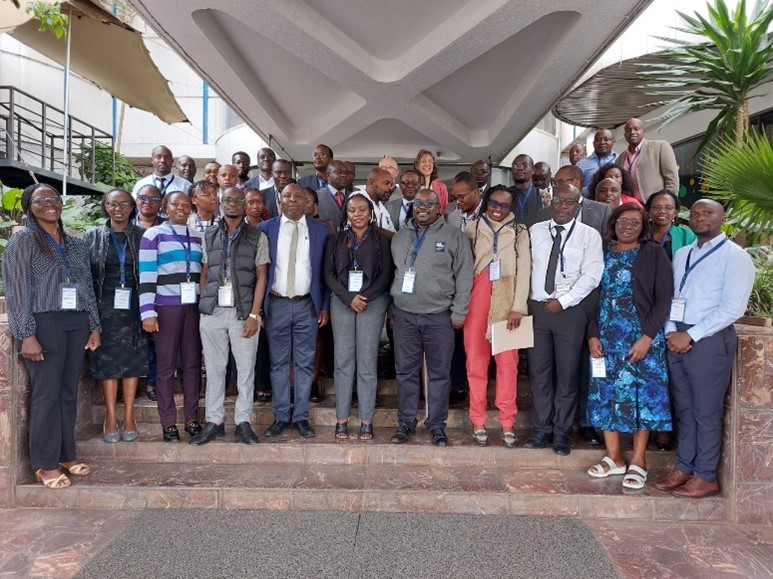
The Kenyan team, supported by ARIN, organised the final stakeholder workshop in Kenya last December. The workshop was well attended with representatives from civil society, the private sector, academia, and government. The focus was on strengthening governance of Sustainable Development Goal (SDG) interactions through improved donor–recipient and inter-donor coordination within Kenya’s dairy sector.
The workshop was opened by WUR’s Dr. Sylvia Karlsson-Vinkhuyzen and moderated by Nowella Anyango-van Zwieten. Two provocative keynotes were given, first by Prof. Owuor Olungah of the University of Nairobi on the need for a strategic, context-aligned vision among aid recipients to ensure that development resources are used effectively and sustainably. He underscored the value of recognizing SDG interactions and fostering multi-stakeholder collaboration particularly the importance of knowing which actors to convene, when, and for what purpose to achieve a shared development vision. The second keynote was delivered by Dr. Dominic Menjo, Advisor on Food Security at the Executive Office of the President. Drawing from a recent report aligning development program loans with the Bottom-up Economic Transformation Agenda (BETA) and County Integrated Development Plans (CIDPs), he highlighted the agenda’s focus on ensuring that development decisions yield tangible economic outcomes for Kenyan citizens. He noted the administration’s ambition to transition from a sociopolitical to a socioeconomic governance model.
The Kenyan team also gave the following presentations:
- Governance of SDG Finance in East Africa by Charles Tonui
- Global-to-local SDG Governance, case of Kenya dairy sector by Annita Kirwa
- Collaboration for sustainable development & Funding modalities in Kiambu county by Rachel Gitundu
- Exploring alignments for SDGs action at the sub-national level in Vihiga county by Dr. Eric Magale
Prof. Olungah thereafter moderated a panel discussion of all four presenters for deeper examination of governance challenges, stakeholder coordination patterns, and the implications of SDG interactions for the dairy sector’s development pathways.
The afternoon session shifted to an interactive co-creation exercise with stakeholders. Participants identified thematic areas of focus across organizations, mapped linkages to specific SDGs, and examined existing and emerging collaborations within the dairy sector. The session also explored donor-recipient engagement dynamics and produced a preliminary mapping of traditional and emerging donors shaping Kenya’s development cooperation landscape. Discussions reflected on evolving global trends and envisioned how Kenya could position itself within a shifting development architecture.
This third stakeholder workshop reinforced the importance of coordinated governance approaches to harness SDG interactions effectively. Insights from research, policy, and practitioner perspectives highlighted the need for strategic visioning, trust-building, and innovation in donor–recipient relationships. The co-creation processes demonstrated a strong stakeholder commitment to collaborative pathways for strengthening Kenya’s dairy sector and advancing sustainable development.
Leave a Reply